Showing posts with label film. Show all posts

Sunday, February 26, 2012

Act of Valor

Early reports are that the film "Act of Valor" is pretty antisemitic. It's tough to get a handle on exactly what's going on (without, you know, seeing it), but I'll try to narrow ir down. Some far-right blogs (that I won't link to, but including Pamela Geller) have compared the film to The Protocols of the Elders of Zion. But even Time describes the portrayal of one of the bad guys as "the avaricious, hook-nosed Jew."

There are two bad guys. One is Muslim -- a Chechyen convert. (A convert from what? I don't know. Probably the film doesn't say.) The other is his Jewish childhood friend. So is it a greedy Jew behind Islamist terrorism aimed at the US? I don't trust the right-wing blogs enough to take their word on this interpretation. Other reviews indicate that he is not the primary bad guy, but a co-bad guy or perhaps a secondary bad guy. It seems just as likely to me that the filmmakers were worried about a potentially negative portrayal of a Muslim, so they added a second, horribly racist character for "balance."

One site with a review that's actually pretty interesting writes:
Somehow the scriptwriters, in an attempt to not alienate the countries known for actively supporting terrorism, managed to find excuses for the SEALs to fight against people in the Philippines, Mexico, West Africa, Russia, Chechnya, and some other ill defined country. The underlying message of the film seems to be “If you aren’t American you suck” and that message is delivered with bullets.
Apparently Jews don't make the cut as Americans.

In any case, please don't pay money to see it. It's getting pretty bad reviews, anyway.

(As more of an aside, though, it's a shame here to rely on right-wing blogs and a few references to mainstream or non-partisan blogs. One of the most significant ways that antisemitism is structured is by silence -- so that few people have a clue what it is or how serious it is -- which is the primary approach to antisemitism of the anti-racist blogs I would normally look to for better reviews. There have been numerous calls for the Left to take the cause of antisemitism back from the Right, which has seized it primarily because of the Left's negligence. Most of the Left only deals with antisemitism at all when it is getting in the way of their criticizing Jews for something else. However, even most of the Leftists calling for such a thing haven't actually done shit about it.)

Tuesday, June 22, 2010

Breaking News Alert: Judd Apatow is Jewish

An interesting review of the latest Apatow-gang film, here at Zeek.
Although religion is rarely evoked, it is nonetheless clear to anyone who is educated on the subject that their male protagonists are at least culturally Jewish. Indeed, Apatow’s camp has been called a “Jew Tang Clan,” playing off the name of the Wu-Tang Clan, a highly productive Staten Island hip-hip collective. By itself, this emphasis on identity might not seem particularly noteworthy. It’s not as if Hollywood has avoided Jewish humor in recent decades. What distinguishes the representation of Jewishness in films like Get Him to the Greek is that it exaggerates the schlub in its boyish men to the point where they veer perilously to negative stereotype.

These aren’t “stealth” Jews, getting to have their ethnic heritage and transcend its historical burden. Even when their romantic exploits succeed, against daunting odds, they remain marked by their deviation from the urbane, polished and post-ethnic masculinity of conventional male leads. Apatow projects may be Cinderella stories, but the magic wand doesn’t redress the superficial imbalance between their male protagonists and the love interests they improbably win over. They are both “everymen,” devoid of the special traits that stardom normally demands, and decidedlyJewishmen.
The character of Aldous Snow (in Forgetting Sarah Marshall, at least - I've yet to see this one), by being British and named Snow, is an exaggeration of whiteness every bit as much as these schlubs are exaggerations of Jewishness. Unfortunately, most audiences, reviewers, and critics just ignore the Jewish elements of the Jew-Tang Clan.
Unless, that is, members of the audience fail to recognize them as ethnic at all. One of the signal developments in postwar American Jewish history is a gradual decrease in visibility. While it might seem obvious that the protagonists featured in films from the Apatow camp are Jewish, there are plenty of moviegoers in the United States who lack the knowledge and experience to reach that conclusion. Although some of these pictures’ popularity may be a function of this ignorance – would Middle America respond to them as favorably if they were understood as ethnic films? – the degree of integration it indicates is still largely salutary.
Salutory? That's fair, as long as it is recognized that's not always the most important question. It's pretty clear from Apatow's films and a host of other places -- indeed, from the creation of Zeek, itself, founded with the recognition that Jews in journalism tend to hide their Jewishness -- that there's been a need to find new ways to express Jewishness. To be Out. That word appears in Michaelson's editorial and also in Jon Stratton's Coming Out Jewish. It's a word I like to describe a dilemma of contemporary Jewihsness.

This isn't always the most important question, either, but it's one I find interesting because it points to the relationship between Jews and the Left: Would feminists respond as critically if the ethnic character of these films, which the filmmakers strive to exaggerate, weren't so thoroughly erased? Such criticisms are right, so far as they go (in that they're not the only audiences erasing Jewishness), but it sure is frustrating.

Friday, May 21, 2010

Defamation

Saw the documentary Defamation, by Yoav Shamir, today. It's available for instant watching on Netflix. Here's David Hirsch's review at Engage Online:
The Bolsheviks used to aim to hit an enemy hard at its strongest point in the belief that a telling blow there would bring down the whole edifice. By contrast, Yoav Shamir, the Israeli director of the film Defamation, shown on More4 this week, chooses mainly easy targets. He presents some interesting material but he does so in a way that does not make the most of it.
My problem isn't the the filmmaker goes after easy targets, but he does so with a proud lack of context and an uninquiring mind. Hirsch also complains that the scene in which he appears was not accurately depicted. The filmmaker focused on some right-wing Jewish responses, ignoring most of the room. Hirsch, who found his way into the film by criticizing Israeli policy in the West Bank, goes on:
The truth is it doesn’t require much courage at all to stand up and oppose Israeli human rights abuses. People do it all the time. Israelis do it all the time. It is the illusion of the moment, pushed by films such as Defamation, pushed by the self-promotion of the anti-Zionists that there are fearsome prices to be paid for supporting Palestinian liberation. Personally, I find it much more frightening to stand up for a democratic and genuinely liberational kind of criticism against the current British orthodoxy of casting Israel, and the Jews who support it, as uniquely and especially threatening.
In many ways, Defamation seems to aim at a particularly sophisticated audience. One that will understand that when the director's voice says (about 11 min in), "The headline [on antisemitism] in the Israeli paper was quite worrying. I wanted to see how the Anti-Defamation League actually fights antisemitism" it's only the setup to a joke. The next shot uses a handheld camera, intentionally off-kilter, to suggest an unprofessional feeling and that the ADL isn't to be taken seriously. An audience that would understand why he contrasts his narrator's voice saying that he's never known real antisemitism, since he grew up in Israel, with his own grandmother saying, "Jews love money. Jews are crooks." In other words, an audience of Sander Gilman.

There are serious questions there, but Shamir has more fun playing around, poking fun at a particular Jewish self-image without ever looking at the context of the Jewish condition. However, it's well worth seeing just to get a look at how pathetic Norman Finkelstein is at the end. even though Shamir is predisposed to portray Finkelstein positively, as reminiscent of "the Biblical prophets of Doom, who were always being pelted with stones for saying things nobody wanted to hear," Finkelstein is himself a pretty soft target for abuse. Throwing Nazi salutes while complaining about being called a self-hating Jew is perfect material for Shamir. After being challenged on comparing Abe Foxman to Hitler, Finkelstein ups the ante, "It's an insult to Hitler." But he's also an important enough target and a public figure.

Saturday, April 24, 2010

To Have and Have Not

Watching the film on PBS with my wife, introduced by a film scholar. Didn't know Lauren Bacall (aka Betty Joan Perske) was Jewish. Or that she hid her Jewishness in the face of Howard Hawks casual antisemitism.

Monday, August 31, 2009

The Reader -- far worse than I'd imagined

Wound up seeing it Saturday night. Had no desire, but Soo put it on our Netflix queue for some reason. It was for worse than I'd imagined.

Look at just the first 10 seconds of this trailer. A wealthy Jew in a large Manhattan apartment that must cost several million, handsomely appointed with art and furniture. A stern look on her face, arms and legged crossed. She's closed off and in control. A German, played by Ralph Fiennes, is bent over with his elbows on his knees. He's embarrassed and doesn't know quite how to begin his plea. The contrast is made even more striking by two shots missing from the trailer. Her face is shown in extreme close up, cutting off the top of her head and bottom of her chin, so that she dominates the screen. The camera cuts quickly back to Fiennes, palpably smaller, fragile. A very powerful Jew and a very meek German. The Jew, in this case, is a Holocaust survivor, and Fiennes is there to represent a Nazi guard. It's hardly typical of survivors that they are rich (even for those who have written memoirs), or for their Nazi guards to have been illiterate. An even greater inversion: the guard has committed suicide, but here the survivor continues on without any noticeable effects. She speaks of the sentimental value of a tea tin, not of fear and death. In order to elicit sympathy for the poor, unfortunate Nazi guard who was just a victim of her illiterate circumstances -- and how could an illiterate understand the moral weight of mass murder? -- the film inverts everything.

Though the intention isn't to trample on the memory of the Holocaust, by such inversions the film recreates the very same arguments about powerful Jews and weak Germans that led to the Shoah. Humanizing the Nazis is important firstly because the Holocaust didn't need monsters. Human beings with human failings and only good intentions so far as they could understand were enough.

In fact, my mother spent some time in Germany a little bit after the time of the film's trial. Germans were still very much in denial, convinced that "ordinary Germans" were completely unaware. The film is, in that simplest of ways, without having to resort to selecting unrepresentative cases, inaccurate. It assumes the moral weight of the Holocaust needs only allusion, but it was and is still debated. Not only are there still deniers of the crudest kind, but also those who wish to lock the Shoah in the distant and best forgotten past, who don't want to deal with the implications or how to make this world safe for Jews. Without a real, honest, and cutting portrayal of the suffering its heroine knowingly caused, The Reader cannot earn for her or for itself the redemption and sympathy it seeks.

Thursday, August 27, 2009

Inglourious Basterds

Saw it last night. Enjoyed it. One of the major concerns of reviewers was that it was too violent, even sadistic. But for several reasons, including a cameo by Mike Myers, it's just too hard to take the film seriously enough for that charge to really stick. Some very real moments, like the inclusion of Emil Jannings, who really was awarded the title "Artist of the State" by Goebbels, ground the film in just enough fact to mean something beyond fantasy, but it was self-consciously an exercise in fantasy. Or, as some people have less generously offered, Tarantino is a parody of himself. For the same reasons, my concerns about portraying Jews as vengeful, a long-established stereotype that dominated my thinking about the film since I first heard of it, didn't seem significant.

On the other hand, there were several things that were worthwhile. Or perhaps could have been with more attention. An early speech by the "Jew Hunter" explains a particular sort (or aspect) of antisemitism. (It's early enough in the film that I don't really think of it as a spoiler. On the other hand, there are, naturally, later parts of the movie this scene relates to, which I am concealing.) This clip is shortened from what's in the film. In it the Jew Hunter explains that Germans are like hawks while Jews are like rats. Missing from that clip, however, is his explanation for why he's so good at hunting Jews. Unlike most Germans, he doesn't think it's a bad thing to be like a rat, and so he's able to think like a Jew. He goes to great lengths to compare rats to cute and cuddly squirrels to explain that there's nothing really wrong with rats -- before offering that "You don't like them [rats/Jews]. You don't really know why. You don't like them. All you know is you find them repulsive." So it isn't really that Jews are necessarily bad or even different. The Jew Hunter is the same. But not. Jews and the Jew Hunter are as alike as rats and squirrels. "Except for the tail, they even look alike."

And it really can't be that Jews are different. Even for the Nazis who went to such great lengths to explain why Jews are different, the laws they implemented went to great lengths to make it so that Jews were different. "Jews" (as the Nazis defined Jews, rather than how various German individuals would have identified) were forced to wear yellow stars, not because of difference, but to make difference. It's not Jewish difference that frightens; it's similarity. Or specifically, uncanniness. Most people have probably heard of the uncanny valley. So long as robots are obviously robots, we have no problem, but as they become too similar, we reject them as grotesque. And many antisemites have great love for Jews so long as Jews are oppressed, but they recoil at Jewish liberation.

The same is at work when Aldo carves a swastika (same spoiler disclaimer as above - it's an early moment) into a Nazi. After the war, he'll take off the uniform and become like everyone else. But even in a revenge fantasy, isn't there a real difference between an Nazi and a Jew?

On the other hand, like most Tarantino films, I don't think any theme is really carried through. There's a moment here and a reprise there. The analysis of this one moment (though there are many interesting moments and one or two elements I'd particularly like to discuss, but that really would be giving too many spoilers) shouldn't be taken as the suggestion that there's really anything heavy about the movie -- perhaps in a few years I'll return and decide -- or not -- beyond Tarantino's claim that Jews deserve an uncomplicated fantasy of killing Nazis. On that score, it delivers pretty well.

Wednesday, August 5, 2009

Coen Brothers, Jewish filmmakers

Apparently, the film, Barton Fink, "has also been studied in circles devoted to Holocaust scholarship, of all things."
The year is 1941, Fink is recognized as a Jew (and subsequently slandered), and the other specifically Jewish character in the film is the subject of some racial slurs from his Hollywood exec boss (who briefly alludes to his Russian heritage). The image of the shoes left in the hallway for collection is striking, and Barton is unable to reach his family while staying in the hotel. Mayhew (the John Mahoney character) writes a book called Nebuchadnezzar, reviled in Judaism for the destruction of the temple, and later when Fink opens his bible he comes across a passage in which Nebuchadnezzar has people cut into pieces for failing to interpret his dream (also a connection to Barton's inability to interpret his own dreams as he faces writer's block). Then there are the two detectives, one German (detective Deutsch), one Italian. Most obvious, and the only thing that really directly suggests such an interpretation, is the finale, in which Goodman (whose real name is revealed as Mundt--a German name) kills detective Deutsch after proclaiming a "Heil Hitler."
That's about it from this article (via). The rest of the article is devoted to another interpretation. But, still, it's interesting. The Coen's are known to have more explicitly Jewish films coming up, including A Serious Man and an adaptation of Michael Chabon's The Yiddish Policemen's Union. Previously, I asked about Burn After Reading, "I wonder if anyone else would argue for the film as a response to antisemitic conspiracism?"
It begins with a God's-eye view descending into a CIA building in DC. Inside, the camera follows, from floor-level, someone. Because the camera is so low, we are necessarily looking up at this person, giving them a sense of stature and importance. Yet we can hardly see above his knees. Immediately, the film jokes by contrasting the all seeing, which lacks detail, with the all-detailed, which lacks context.
At the time, I saw it as unlikely that there was an ethno-religious tint to the major themes, but it seems now harder to deny that the filmmakers are concerned with such matters and that such readings are appropriate (if only partial). Maybe time for a Netflixed retrospective for me.

Thursday, July 16, 2009

Yoo Hoo!

I saw the documentary, Yoo Hoo, Mrs. Goldberg, by Aviva Kempner, last nigh. Here's the film website, a NYT article, and here's Rotten Tomatoes, where the film is rated 92% fresh. Unfortunately, it's in limited release, and Molly Goldberg/Gertrude Berg will probably remain for most people the most famous woman you've never heard of.

That so few know who she is shouldn't be understood to qualify her fame. She was incredibly popular, ranked by a popular magazine (I forget which, unfortunately, but a major, widely read mag) as the second most influential woman in America behind Eleanor Roosevelt (and the richest woman ahead of ER). Her television show was the highest rated on television for almost a decade. The radio show that preceded tv was as popular for twice as long, so her rain as a pop icon ("The Oprah of her day") ran from the early 30s into the mid 50s. And if not for McCarthyism, Lucille Ball might never have had a shot to replace here.

The audience was lively. Judging by their accents (it was too dark for racial profiling) and their vocal or otherwise palpable reactions to much of the film, most in the theater were Jewish. My wife might have been the only one who wasn't. And the two of us might have been the only ones this side of 60. People were there to revel in nostalgia. Like my mother, they grew up watching The Goldbergs, and that was very much their story. Of course, as the film makes clear, it was the story of anyone who grew up in a family. But if you were other than WASPy, it was even easier to identify with it as your story. And if you were a New York Jew, then you might have felt like you owned the story. (And if your name happened to be Goldberg, well..) Before the show, one woman asked the assembled, "Anyone here from the Bronx?"

A few things in particular caught my attention. One, the early success of the radio show was around the same time as the rise of fascism world-wide. Given her success, it might have been easy to argue the US was incredibly tolerant to Jews in a way that ignored that it was also a time when the German-American Bund, Charles Coughlin, and the America First Party were popular and influential. Unlike Hollywood, she even had an episode (only one) with a brick thrown through her window. This really drove home to me something that's been true of antisemitism at least since Augustine, that elements of tolerance and success for Jews are not dispositive of Jewish oppression. In fact, they coexist rather well.

Two, Ed Asner's interview was quite different from the rest of the film. Though Gertrude Berg herself was born in the US, the character Molly Goldberg had some vaguely Eastern European accent. Through most of the film, I was amazed at this brazen willingness to express difference, something I wish was more pronounced today. But for Asner, who grew up wanting to fit in and hide his difference, that foreign accent made him incredibly uncomfortable.

Three, and for this you see the film (in part because I don't want to render it superfluous for you and because I really couldn't convey this) was the role of antisemitism in McCarthyism. When her costar Philip Loeb was targeted as a supposed Communist (he was a prominent trade union activist), Berg fought for him and stood up to General Mills - and it ruined her. There was a certain Catholic cardinal who could have made it all go away - but he insisted she convert. It was a proud, but unsurprising moment when then off-Broadway play that played a huge role in breaking McCarthyism was The Life of Sholem Aleichem.

At present, it's only showing in New York, at the Lincoln Plaza Cinema or the Quad Cinema. Tomorrow it opens in DC and one theater on Long Island. Next week, it goes into somewhat wider release. Check at the film's website to see if it'll be near you.

Tuesday, June 16, 2009

LGBT Community on Film

From WNYC:
June marks the 40th Anniversary of Stonewall. We're commemorating the occasion by talking about representations of LGBT life and politics on film as part of our Projections series. Film critic Nathan Lee, professor of Cinema Studies at CUNY David Gerstner, and by filmmaker Cheryl Dunye join us to discuss the following films:
"The Boys in the Band" (1970) "Parting Glances" (1986) "The Watermelon Woman" (1996) "Milk" (2008)


The discussion is fascinating for several reasons. At one point one of the guests suggests that representation on film is crucially important for gays in a way it isn't for many other oppressed groups because they pass in everyday life. In that way, I think a lot of it is also relevant for Jews. In particular, there's a discussion of how gays are more welcome on the screen when they die at the end of the film. It was progress when they only wound up severely emotionally damaged rather than dead. Let me recommend for comparison, The Pawnbroker and Sophie's Choice.

(Video might show up around here at some point. Since they watch film clips during the show, video might be helpful, but I think most of what's important comes through in the audio.)

Friday, April 24, 2009

Funny People

The film, coming out in July, looks good. Watching the trailer, I caught something. Eric Bana plays hyper-masculine jerk, Clark.

Remember, from Knocked Up, "If any of us get laid tonight, it's because of Eric Bana in 'Munich.' " Put that in your Film Art and smoke it.

A neat little casting trick from Apatow, who continues to impress as someone far more serious about film than most imagine him to be.

Tuesday, March 31, 2009

Defiance

Hey, my piece on Defiance and Jews in film more generally, is up at Racialicious.
I found Defiance moving, but also entertaining. It swells with action in the best tradition of Hollywood. For some people, this is a problem. The most commonly expressed fear of directors making films about the Holocaust is that they will trivialize and exploit the tragedy. Ralph Seliger complains about historical inaccuracies and that the Bielskis are cheapened as “the image of Hollywood heroes.” My concern is different. There were six Holocaust films out at one time, but given the history of how Hollywood has depicted Jews and the Holocaust - and the way in which I understand antisemitism as shaping that depiction - Defiance was the only one I had any interest in seeing.
Read the rest.

Tuesday, March 10, 2009

Burn After Reading

Saw Burn After Reading by the Coen Brothers over the weekend. The following contains mild spoilers.

It begins with a God's-eye view descending into a CIA building in DC. Inside, the camera follows, from floor-level, someone. Because the camera is so low, we are necessarily looking up at this person, giving them a sense of stature and importance. Yet we can hardly see above his knees. Immediately, the film jokes by contrasting the all seeing, which lacks detail, with the all-detailed, which lacks context.

It's a farce about middle aged characters, most of whom are sleeping around with each other, all of whom are trying to assert control over their lives and world around them. The MacGuffin is a CD-Rom with, as Brad Pitt's character puts it, "intelligent shit" from the CIA. So in addition to being a sex farce, it also works as a spy farce. While everyone strives for control, nobody, not even the CIA, has any idea what's going on. It's a perfect parody of conspiracism.

Turns out this person we're following, played by John Malkovich, wearing a 3-piece suit and bow tie, enters a meeting where he is demoted. The stature and importance the camera gave to him in the hallway is a bit of a joke. A coworker accuses the Malkovich character, Ozzie Cox, of being a drunk. The accusation is true (a later allusion to the Rio Bravo scene where Dean Martin pours a shot of whiskey back into the bottle without spilling a drop makes this clear), but Cox responds by accusing his Mormon coworker of seeing everyone as a drunk. Cox claims in the meeting he is being crucified.

At home, his wife walks in and asks if he picked up the cheeses. It's intentionally difficult to hear, as his wife is at the front door while the audio is from the kitchen. It wasn't just me - after the reference to crucifixion in the previous scene, Soo also heard some mumbling about "Jesus" instead of "cheeses." The mishearing speaks to limited information with which to understand the world, undermining notions of knowability.

Later, after meeting the Frances McDormand character, after her insurance company has refused to cover several cosmetics surgeries, she is seen with her head down and palms up as if pleading in frustration. On the wall behind her is a meditating Buddha, head up and palms on knees, which really digs in at her inability to accept change.

All of these references to religion so early on -counting liberally, there's 5 that I mentioned; to be overly conservative, there's at least 3- made me wonder if the Coens were saying something from a Jewish perspective. We know they picked up the adaptation of Michael Chabon's The Yiddish Policeman's Union, so it seems they'd like to say at least a little from that particular perspective. The timing is about right for the film to be a response to Mearsheimer and Walt. But I doubt it. It seems like an over-determined reading.

Except for one minor character being Mormon, all of the religious references -even the cheeses- speak directly to power and control, obvious themes in the film. So they don't really push for a "Jewish" interpretation. Unless we deny that the Mormon reference can just be folded into the others. (For what it's worth, there's no reason to think religion should suggest morality. There is no sense of morality, just absurdity and irony.)

I wonder if anyone else would argue for the film as a response to antisemitic conspiracism?

Tuesday, February 24, 2009

The Reader, "pernicious"

I haven't seen it, don't want to. My first thought about it was that it was yet another Holocaust movie not about Jews. (Schindler's List - protagonist is the Good German. Sophie's Choice - among other things I've said about it, the protagonist is a Pole. The Diary of Ann Frank - they took every step to trivialize Frank's Jewishness.) But then there was Ron Rosenbaum's plea at Slate not to give the film an Oscar. "We don't need another 'redemptive' Holocaust movie." The review is damning, and solidified my personal feelings against seeing the film. Now, here's more from historian Deborah Lipstadt:
This is a rewriting of history. It is, simply put, soft core denial. It does not deny the reality or the horror of the Holocaust. Not at all. But it does deny who was responsible.

Tuesday, February 10, 2009

Shoah not a heartwarming story.

Ron Rosenbaum is as ticked at Hollywood's Shoah-fest as I am. Defiance is the only one I saw, and the only one I wanted to.
But that's what The Reader is about: the supposedly difficult struggle with this slowly dawning postwar awareness. As Cynthia Ozick put it in her essay: "After the war, when she is brought to trial, the narrator ['Michael Berg'] acknowledges that she is guilty of despicable crimes—but he also believes that her illiteracy must mitigate her guilt. Had she been able to read, she would have been a factory worker, not an agent of murder. Her crimes are illiteracy's accident. Illiteracy is her exculpation."

Indeed, so much is made of the deep, deep exculpatory shame of illiteracy—despite the fact that burning 300 people to death doesn't require reading skills—that some worshipful accounts of the novel (by those who buy into its ludicrous premise, perhaps because it's been declared "classic" and "profound") actually seem to affirm that illiteracy is something more to be ashamed of than participating in mass murder. From the Barnes & Noble Web site summary of the novel: "Michael recognizes his former lover on the stand, accused of a hideous crime. And as he watches Hanna refuse to defend herself against the charges, Michael gradually realizes that she may be guarding a secret more shameful than murder." Yes, more shameful than murder! Lack of reading skills is more disgraceful than listening in bovine silence to the screams of 300 people as they are burned to death behind the locked doors of a church you're guarding to prevent them from escaping the flames. Which is what Hanna did, although, of course, it's not shown in the film. As I learned from the director at a screening of The Reader, the scene was omitted because it might have "unbalanced" our view of Hanna, given too much weight to the mass murder she committed, as opposed to her lack of reading skills. Made it more difficult to develop empathy for her, although it's never explained why it's important that we should.

Tuesday, December 30, 2008

Who'd a thunk of it - a bad nazi?

In the mid-'60s, critic Judith Crist quipped, "[A] screenwriter, with a revolutionary glint in his eye was telling me the other day he's going all-the-way original; he's writing a World War II movie with bad Nazis."
Really, there aren't that many Holocaust movies, when you consider how big an event it was in world history and how many people it touched. This year, however, there are a bunch out for the holidays. (Valkyrie came out Christmas day.) But perhaps people are starting to notice how absurd these films tend to be. (Via)

Monday, December 8, 2008

For a Shoah-free Christmas?

Stuart Klawans calls for a moratorium on Holocaust movies. "Lest We Remember: Saying never again to Holocaust movies." What struck me:
In fact, some of them can scarcely bring themselves to put a Jewish character on the screen. Valkyrie, for example, is based on the true story of Colonel von Stauffenberg and the plot to assassinate Hitler, which means the exciting foreground of the movie can be filled with German staff officers, while the victims of genocide linger in the rear as a kind of atmospheric effect. This is convenient for the director, Bryan Singer, whose 1998 Apt Pupil delved into the awful fascination that Nazism exerts on young minds, the better to fascinate an audience with the exact same thrills. I predict Valkyrie will offer you even spiffier uniforms, louder commands, bigger guns, and (with the presence of Black Book’s Carice van Houten) maybe a little sex. The action should be everything you’d want from the maker of X-Men.
So, like Sophie's Choice and Schindler's List. Of course, Anne Frank was about a Jew, but deracinated and distant from the genocide -conveniently for a Hollywood insistent on happy endings- during the writing of the Diary.

From The Holocaust in American Film by Judith E. Doneson:
Now, Meyer Levin's major complaint about the play throuout the years had been that it ignored the Jewish content of Anne's book, a very apparent Jewishness, as in this passage:
Who has inflicted this upon up? Who has made us Jews different from all other people? Who has allowed us to suffer so terribly up till now? It is God that has made us as we are, but it will be God, too, who will raise us up again. If we bear all this suffering and if there are still Jews left, when it is over, then Jews, instead of being doomed, will be held up as an example. Who knows, it might even be our religion from which the world and all people learn good, and for that reason only do we have to suffer now.
Levin quite rightly viewed this as a central idea of the Diary. And his anger was justified when in the final version of the play, Anne's words had been changed to read: "We're not the only people that've had to suffer There've always been people that've had to...Sometimes one race...Sometimes another...and yet..."

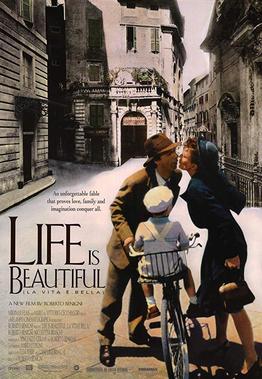
I doubt antisemitism has ever been as simple as a dominant view of Jews as subhuman. Certainly, it hasn't been that simple for a long time. Even in pre-Nazi Germany, the dominant view was intolerant of Jew-hatred. But anti-antisemitism has always been blunted, so that Jew-hatred was able to reinvent itself as antisemitism. So it's important to me to ask -though I know there are many stories to tell about WWII besides the Jewish one- how the hell can we talk about antisemitism while we keep backgrounding Jews in the retelling of the Shoah? Or giving Oscars to Roberto Benigni.

I'm sure it's just coincidence that these films are out for Oscar season, which happens to concur with the annual aural assault of Christian dominance. But looking at that poster, above, I'm not sure I could really tell Life is Beautiful from Home Alone at the video store.

Monday, August 18, 2008

Friday, August 8, 2008

Sophie's Choice

Saw the film, directed by Alan J. Pakula. First, do let me say it's very moving. Despite the questions I had (from very early on when the 'ethnic kingdom of the pink palace' is painted that color because of the Jewish landlord's frugality), they never removed my concern for Sophie (Meryl Streep) as a Holocaust survivor dealing with the memory. I would recommend seeing it. And there's also a documentary on the DVD that discusses the theme of survivors' guilt in the film which is very worth watching. Even if what I say were to dissaude you from seeing the film, it would still be worth it to see it so that you could also watch the documentary. However, it also needs to be critiqued something fierce. The novel, by William Styron, won the National Book Award and is widely considered a classic. The film is #91 on the American Film Institute's list of the 100 best films ever. This post is based entirely on the film.

While I knew it's been somewhat criticized as one of surprisingly many Holocaust films that are not primarily about Jews, there's more to it that I think is extremely disturbing. [What follows contains many spoilers of varying degrees.]

Set shortly after WWII in the late 40s. Sophie is a Polish Catholic survivor of Auschwitz. Nathan (Kevin Kline, who's at his best) is her Jewish, American boyfriend who didn't even fight in the war. Though brilliant, expansive, and generous in a way, Nathan is also prone to extreme jealousy and emotional cruelty. He is a liar and has a frighteningly violent, perhaps homicidal, streak. The first time Nathan and Sophie appear onscreen, they are arguing on the stairs. Nathan rattles off a list of diseases to compare Sophie to before he turns to Stingo (the narrator, typically assumed to be Styron) to ask (miming masturbation) if he got off watching the fight. He is diagnosed as a paranoid schizophrenic, though this is so shallow that even director Pakula incorrectly describes him as manic-depressive in the commentary. That's a better fit with Nathan's behavior, but still it's neither completely necessary or satisfactory to explain Nathan's actions. Rather, Nathan's Jewishness is the reason for his craziness. The actual diagnosis is superfluous.

The only other Jewish character given any real screen time is Leslie Lapidus, an archetypal Jewish Princess. She compulsively talks about fucking, inviting Stingo to her house for the weekend while her parents are away. She immediately begins making out with him, but when Stingo puts her hand on his penis she screams. It comes out that she has reached a "plateau" in her therapy so that she is now capable of saying "fuck" but she is still incapable of going past making out. So, in a comic way, we see the stereotype of rich, vulgar, neurotically frigid, Jewish girls.

Returning home from Leslie's, Stingo talks with Sophie. Sophie is everything Leslie is not as a woman. Sensual and deep with real tragedy in her life in contrast to Leslie's neuroticism. They talk about Sophie's past, how her father had helped the Jews before the war and how Sophie wound up in Auschwitz. Sophie brings Stingo into Nathan's room searching for more liquor. There are books about and pictures of Nazis and Holocaust victims filling the room. She explains that Nathan is obsessed with Nazis escaping justice. Stingo naively understands that a Jew would be obsessed by such a thing when Sophie corrects him, comparing Nathan's experience to hers. "You don't know him." (Quotes may be imperfect.) When Nathan shows up he describes the room as his "sanctum sanctorum" saying to Stingo "now you know my deepest secrets." The scene explicitly pits Sophie's experience against Nathan's obsession with Nazis escaping justice. In that way, it demeans the way American Jews were affected by the Holocaust. In Stingo's desire for Sophie and her mature sexuality, the victim is feminized so that Stingo can romanticize the oppressed and match a philosemitic understanding of Holocaust victims with an antisemitism directed at Jews when they are not saliently oppressed.

Before Nathan defuses the situation by changing topics, he is clearly angry and threatening. We identify with Stingo as he vies with Nathan as Sophie's protector, suppressing the need for a Jewish role in fighting antisemitism. Or, indeed a Jewish role in antisemitism at all, as Sophie substitutes for Jews. Yet she is a deeply traumatized and scarred woman who cannot find what she needs in a healthier relationship. It makes sense she would seek out someone else also deeply damaged. She ultimately embodies the philosemitic/antisemitic narrative that Jews' own insanity, the result of past antisemitism, is the source of future Jewish tragedy while inverting the Jewish role in the tragedy so that Jews become the oppressors.

Monday, June 30, 2008

Paper Clips, meh

Saw the documentary Paper Clips. (Googling "paperclips bring up several sites related to the movie right at the top. Wonder if that reflects the significance of the film or the mundaneness of paperclips.) It depicts a middle schools efforts to learn about the Holocaust.

Through Holocaust survivors who visited the school, and probably other means, it's clear the students came to feel for and sympathize with Jews and also learned about the process of racism. What's less clear is whether they were able to see these Jews as more than victims. For the film's audience; however, Jews remain essentially victims. Moreover, the tone is triumphant, reinforcing the idea that antisemitism is a thing of the past. Rather than combating antisemitism, the film is likely to reinforce Jews' status as the other, still with screwy issues of agency.